Every summer in Canoga Park follows the same pattern. Temperatures climb into the triple digits in June. Emergency AC repair calls spike. And a significant portion of those calls — the ones that could have been avoided — come from homeowners whose systems had not been professionally serviced in two or three years.
A capacitor that was reading low in March becomes a failed capacitor in July. A refrigerant level that was slightly off in April becomes a frozen coil in August. A condensate drain with partial mineral buildup in May becomes a flooded air handler in September. These are not unpredictable failures. They are predictable outcomes of skipped maintenance — and every one of them costs more to fix than a tune-up would have cost to prevent.
This guide covers what a proper AC tune-up in Canoga Park actually includes, what separates a genuine tune-up from a 15-minute visual inspection, what it costs, when to schedule it, and why the combination of Canoga Park’s climate and housing stock makes regular professional maintenance more important here than the national average would suggest.
Cooling By Design is headquartered at 21201 Victory Blvd, Suite 125, Canoga Park, CA 91303. We perform AC tune-ups across Canoga Park and the full San Fernando Valley — licensed (#1148982), insured, and available for spring scheduling now. Call (877) 702-6654.
What a Proper AC Tune-Up in Canoga Park Actually Includes
The word tune-up is used loosely in the HVAC industry. Some companies advertise a $49 tune-up that amounts to a visual inspection, a filter check, and a conversation about upgrading your system. A genuine professional tune-up is a comprehensive, instrument-based assessment of every major component in your system — indoor and outdoor — that produces actionable findings and measurable performance data.
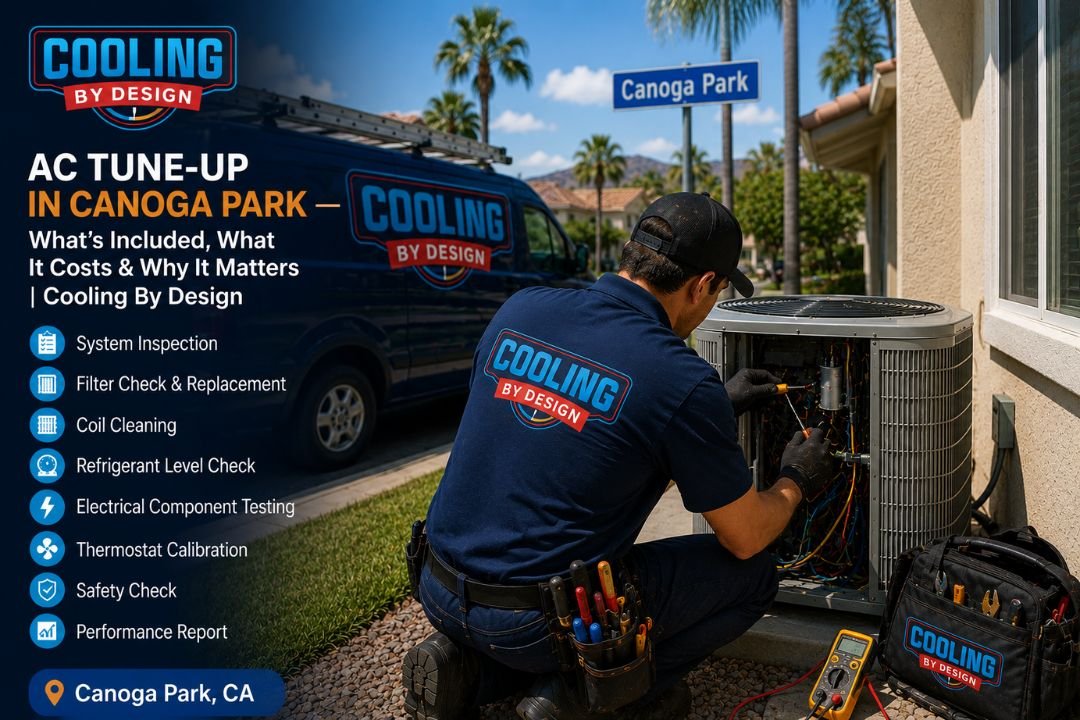
Here is what every Cooling By Design tune-up visit covers.
Air Filter Inspection and Replacement Guidance
Your technician removes and inspects the current filter, documents its condition, installs a customer-supplied replacement if available, and logs the correct replacement interval based on actual filter condition — not the generic 90-day printed on the packaging. In Canoga Park, where dust load from Santa Ana winds and wildfire smoke events accelerates filter clogging, the correct interval for most homes is 30 to 45 days during the cooling season.
Thermostat Calibration and Function Test
The thermostat is tested for accuracy — verifying that the temperature it reads matches the actual indoor temperature, and that the system responds correctly to mode changes, setpoint adjustments, and fan setting changes. Smart thermostats are checked for connectivity, firmware status, and scheduling accuracy.
Electrical Component Testing
This is one of the most valuable parts of a professional tune-up and one that is frequently skipped by companies offering low-cost maintenance visits. Every major electrical component is tested under actual operating load:
- Capacitors — tested with a capacitance meter to measure actual microfarad output against rated specifications. A capacitor reading 20% below rated capacity is a capacitor that will fail within the season — and catching it during a tune-up costs $150 to $300 as a planned repair versus $300+ as an emergency call.
- Contactors — inspected for pitting, burning, and contact point wear that indicates impending failure
- Wiring and connections — all terminals inspected and tightened, insulation checked for heat damage or deterioration
- Breaker and disconnect — confirmed properly rated and showing no signs of heat damage
Refrigerant Pressure Measurement
Gauges are connected to the system’s service ports and actual operating pressures are measured and compared against manufacturer specifications for current ambient temperature conditions. This is the only accurate way to assess refrigerant levels — not visual inspection, not temperature readings alone. If pressures indicate low refrigerant, the technician performs a leak search before recommending a recharge, because adding refrigerant without finding and repairing the leak is a temporary measure that will require another service call within months.
Evaporator Coil Inspection
The indoor evaporator coil is inspected for dirt accumulation, ice formation, and physical damage. A dirty evaporator coil acts as an insulator, reducing heat transfer efficiency and forcing the system to run longer to achieve the same amount of cooling. In Canoga Park, where wildfire smoke and fine particulates pass through filters and accumulate on coil surfaces, professional coil cleaning is often needed more frequently than national maintenance guides suggest.
Condenser Coil Inspection and Cleaning
The outdoor condenser coil is inspected for dirt, debris, and physical damage to the aluminum fins. Cottonwood, olive tree pollen, and dust from Valley wind events are particularly aggressive at coating condenser fins and reducing heat rejection efficiency. The technician clears debris from inside the unit, inspects the fin condition, and performs a rinse cleaning if coil surfaces are obstructed.
Condensate Drain Inspection and Treatment
The condensate drain line is inspected for partial or full blockage, flushed clear, and treated with a condensate drain tablet or biocide solution to prevent algae and mineral buildup. Los Angeles hard water accelerates mineral scaling in drain lines significantly — in Canoga Park, condensate drain clogs are one of the most common causes of system shutdown and water damage, and treating the line at every tune-up is standard practice for any technician who understands the local water supply.
Blower Motor and Wheel Inspection
The indoor blower motor is tested for correct amperage draw and the blower wheel is inspected for dust accumulation. A dirty blower wheel can reduce airflow by 20% or more — enough to cause uneven cooling across the home and increased system runtime. Motor amperage is documented and compared to manufacturer specifications to identify motors drawing higher than normal current, indicating bearing wear or mechanical strain.
Temperature Split Measurement
The technician measures the temperature of air entering the return and exiting the supply registers while the system is running. A properly functioning central AC system should produce supply air that is 16 to 22°F cooler than the return air temperature. A split outside this range — even on a system that appears to be running normally — indicates a refrigerant, airflow, or coil efficiency issue that needs to be addressed.
Overall System Performance Assessment and Written Report
Every measurement and finding from the visit is documented in a written service report provided to you at the end of the visit. This report captures the condition of every component inspected, any recommendations for near-term repair or attention, and a baseline performance record that allows future technicians to compare current readings against your system’s history.
What a Canoga Park AC Tune-Up Costs in 2026
A comprehensive professional AC tune-up in the Canoga Park area typically costs between $89 and $149 for a single system. This range covers a full instrument-based assessment with written documentation — not a drive-by visual inspection.
Be cautious of tune-up offers priced significantly below this range. A $49 tune-up almost always means a shorter visit, limited instrumentation, and a primary goal of identifying add-on sales rather than genuinely assessing your system’s condition. The purpose of a tune-up is to protect your equipment — not to generate a list of repairs you may or may not need.
For homeowners who want to lock in tune-up pricing and add priority scheduling, repair discounts, and emergency fee waivers, our HVAC maintenance plans cover bi-annual tune-ups starting at $25/month — significantly reducing the per-visit cost while adding substantial benefits that pay for the plan repeatedly through a single summer season.
When to Schedule Your AC Tune-Up in Canoga Park
The correct answer is spring — ideally March through May, before temperatures in the San Fernando Valley begin climbing toward their summer peaks.
Here is why timing matters specifically in this market. By June, Canoga Park HVAC companies are responding to a growing wave of emergency calls from systems that have already started failing. Appointment availability tightens. Wait times extend. And because demand is high, there is less flexibility in scheduling. If your system’s tune-up reveals a capacitor that needs replacement or a refrigerant issue that needs addressing, doing that work in April means a planned repair at standard pricing during a time when parts are in stock and schedules are open. The same repair in July means competing for a technician during peak demand, often at emergency service rates.
If you missed the spring window, do not wait until next year. A tune-up in June or July is still far better than no tune-up — and it still gives your system the best possible chance of completing the cooling season without a breakdown. A fall tune-up in September or October prepares the system for winter heating demand and catches any issues that developed during the summer.
Maintenance plan members receive scheduled tune-up reminders and priority booking windows, ensuring they never miss the optimal service window during peak season demand. Learn more about plan enrollment here.
Why AC Tune-Ups Matter More in Canoga Park Than Most Places
Most national HVAC maintenance guides are written for a median American climate — moderate summers, cold winters, and an AC system that runs three or four months per year. Canoga Park is not that climate. Here is how local conditions specifically affect the value of regular professional maintenance.
Longer Cooling Seasons Mean More Annual Wear
A central AC system in Canoga Park accumulates 1,500 to 2,000 operating hours per year — nearly double the national average. Every additional hour of runtime is additional wear on capacitors, contactors, blower motors, and compressor components. A component that reaches end of life after 8,000 hours of operation will fail in four to five years in Canoga Park’s climate versus eight to ten years in a moderate climate. Regular tune-ups catch this accelerated wear before it becomes failure.
Dust, Pollen, and Wildfire Smoke Load
The combination of dry Valley air, Santa Ana wind events, high pollen counts from olive and cottonwood trees, and increasingly frequent and severe wildfire smoke events creates an airborne particulate load that is significantly higher than most of the country. This accelerates filter clogging, coil surface fouling, and blower wheel contamination — all of which reduce system efficiency and increase wear. A tune-up in Canoga Park addresses these specific accumulation points in a way that a national maintenance checklist often does not account for.
Hard Water Condensate Drain Issues
Los Angeles municipal water is among the hardest in the country by calcium carbonate concentration. Mineral scaling in condensate drain lines happens faster here, and algae growth is more aggressive in the warm, humid environment inside a condensate pan than in cooler climates. Canoga Park homeowners who skip annual drain treatment are significantly more likely to experience overflow events and water damage than homeowners in softer-water regions.
Aging Housing Stock and Legacy Equipment
A large proportion of Canoga Park homes were built in the 1950s and 1960s, and many of their HVAC systems — even those retrofitted in the 1980s and 1990s — are aging into the range where component failures become increasingly likely. Tune-ups on older systems are not just preventive maintenance — they are the primary mechanism for tracking the system’s remaining useful life and making informed, planned decisions about replacement rather than reactive ones. If your system is showing wear patterns that suggest replacement is approaching, our AC replacement service includes the 10-Year Cooling Comfort Plan as an option for qualifying new installations.
What Happens If You Skip the AC Tune-Up
The most honest way to explain the value of a tune-up is to describe what happens when it is skipped consistently. These are not hypothetical scenarios — they are the service calls we receive every summer from homeowners whose systems have not been professionally maintained.
- The capacitor fails in July — a $150 planned repair during a tune-up becomes a $300 emergency repair during a heatwave with a same-day service fee added
- The refrigerant leak goes undetected — until the evaporator coil freezes mid-August, causing the compressor to run under abnormal conditions long enough to damage it — turning a $350 refrigerant repair into a $1,500 to $2,800 compressor job
- The condensate drain clogs — overflowing into the ceiling or subfloor and causing water damage that the HVAC repair itself does not cover
- The dirty coil reduces efficiency by 15% — adding $25 to $60 per month to your Edison bill throughout the cooling season — more than the cost of an annual tune-up in the first billing cycle
- The blower wheel accumulates debris — reducing airflow enough that some rooms become uncomfortable while others stay cool, leading to thermostat wars and a system that never fully satisfies
None of these outcomes are dramatic in isolation. Together, they represent the real cost of deferred maintenance — a cost that is always higher than the tune-up that would have prevented it.
AC Tune-Up vs HVAC Maintenance Plan — What Is the Difference
A standalone AC tune-up is a single visit — one assessment, one report, no ongoing commitment. It is the right choice for homeowners who want to service their system before a season without making a longer-term arrangement.
An HVAC maintenance plan covers bi-annual tune-ups — spring and fall — on an ongoing basis, with additional benefits that make it substantially more valuable than the sum of its tune-up visits alone. Here is the practical difference.
- Design Comfort Plan at $25/month — one annual tune-up, priority scheduling, 20% off all repairs, reduced emergency fees
- Design Comfort Gold at $35/month — two annual tune-ups (spring and fall), priority scheduling, no after-hours trip charge, 20% off all repairs
- Design Comfort Platinum at $39/month — two annual tune-ups, two free diagnostic visits per year, no after-hours trip charge, 20% off all repairs
For most Canoga Park homeowners, the Gold plan is the correct standard of care — bi-annual service aligned with the pre-cooling and pre-heating seasons, with the emergency fee waiver providing value that often exceeds the entire annual plan cost from a single after-hours call. View and enroll in a maintenance plan here.
Frequently Asked Questions
How long does an AC tune-up take in Canoga Park?
A comprehensive professional tune-up typically takes 60 to 90 minutes for a standard residential central AC system. Systems with significant coil fouling, multiple zones, or additional equipment may take longer. We give you an accurate time estimate when scheduling.
What is the difference between an AC tune-up and an AC repair?
A tune-up is a scheduled, proactive assessment performed on a functioning system to maintain performance and catch developing issues early. A repair is a corrective visit performed because something has already failed. A tune-up often identifies components that need repair — allowing those repairs to be scheduled as planned work at standard pricing rather than as emergency calls.
How often should I get an AC tune-up in Canoga Park?
Twice per year — spring before cooling season and fall before heating season — is the correct interval for Canoga Park’s climate. Once per year is the national minimum recommendation, but given the Valley’s long cooling season, high particulate load, and hard water conditions, bi-annual service is the standard we recommend and practice.
Can I do an AC tune-up myself?
Homeowners can and should replace filters, clear debris from the outdoor condenser, and check thermostat settings. The core value of a professional tune-up — capacitor testing under load, refrigerant pressure measurement, electrical connection inspection, condensate drain treatment, and temperature split analysis — requires specialized tools and EPA certification for refrigerant work. These are not DIY tasks.
Will an AC tune-up fix my AC if it is not cooling properly?
If the system has an active problem causing poor cooling — low refrigerant, a failing component, a frozen coil — a tune-up visit will identify and diagnose it. Depending on the finding, the repair may be performed during the same visit or scheduled as a follow-up depending on parts availability and scope. If you have an active cooling problem rather than just wanting routine maintenance, our AC repair service is the appropriate starting point.
Does a tune-up help with high electricity bills?
Yes, directly. A dirty condenser coil, low refrigerant charge, or restricted airflow all cause the system to run longer to achieve the same amount of cooling — consuming more electricity per degree of temperature reduction. The Department of Energy estimates that a properly maintained system consumes up to 30% less energy than a neglected one. In Canoga Park’s long cooling season, that efficiency gap represents hundreds of dollars per year on your Edison bill.
Schedule Your AC Tune-Up in Canoga Park Today
The best time to service your AC system is before it needs repair — not after. Call (877) 702-6654 to schedule your AC tune-up in Canoga Park, email us at office@coolingbydesign.com, or book online here.
Ask about our HVAC maintenance plans starting at $25/month — the most cost-effective way to ensure your system is professionally serviced every season without having to remember to schedule it. License #1148982. 21201 Victory Blvd, Suite 125, Canoga Park, CA 91303.